Te amo sempre, filha
It was the summer of 2025 in Brazil, which is the winter for the United States. Though the seasons may be flipped, a difference of 4,000 miles cannot change the tick of time, just the hemisphere. It didn’t feel that way though. It had been three years since I lived in Brazil, and it was my first time returning to the city that I called home for ten months. Curitiba, or “Chuvatiba.” Chuva means rain in Portuguese, and it is what my host family called this green, busy place on the many rainy days that it was known for. As of 2023, it was the fourth wealthiest city in the richest country in South America, and though there were BMW cars and women walking with YSL bags, they drove along the same streets as people pushing carts full of trash with stray dogs darting out of the way of their tires.
“Acho que você gostaria dessa padaria,” my host mom, Cristina, tells me. I thought you’d like this bakery.
Portuguese is my second language, one that I have dutifully held onto so that I can talk with my family here. I like to think that I fought harder for it than English, which was learned when my brain was still soft and without memory. Portuguese was learned slowly, through months of quietly listening to dinner conversations and hours of Duolingo. My personality slowly unfolded to my host family and peers as I pieced together words and phrases over my ten months abroad. My vocabulary developed over time like my relationship with my host family, the Simonetti’s, who became a real family to me. Not of blood, but of the heart. Marco and Cristina, my host parents, and their son Gustavo invited me into their home. I stayed in the room of their youngest son, Otavio, who was on his own exchange in Mexico. I had a special connection with Cristina, one that has been maintained over years of WhatsApp voice memos and photos of graduations, birthdays and holidays.
In the spring of 2023, in the days before I moved back to the United States, she came into my room in tears. Cristina’s face turned into a frown, a sadness that I rarely saw with her. Tears streaming down under her glasses, she shuffled into my room. It had been days of airport goodbyes as the exchange students in my program all began to take the long journey home, and the grief of a moment nearly gone hung heavy in the house. I opened my arms and she climbed into bed with me, the two of us crying together in silence over the impending loss of simply being a real, present part of each other's lives.
Cristina and I shared interests in hiking, Brazilian samba and telling stories about everyone we’d ever met. Our politics differed, as she was a major supporter of the Brazilian conservative leader, Bolsonaro, and I had become an outspoken liberal after growing up through Obama and Trump’s administrations. I knew I was a lot like the communists that she insisted were taking over the country, that she told me were destroying the Brazilian government with social media. It was easy to forget that the country was still recovering from a military dictatorship because it wasn’t spoken of, at least not in public. When the military took over in 1964, they said it was to fight against communist threats, somehow confusing the president’s basic reforms to expand workers rights with the Russian ideologies that the world feared at the time. Over 400 people were killed or disappeared, and thousands were tortured by the Brazilian government, while thousands more lived without water or functioning sewage systems. Though only lasting just over 20 years, the debt that the authoritarian regime accrued still haunts the country in its young democracy. But not always so negatively, as Bolsonaro himself admired the regime, to the point of planning his own military coup after losing the presidential election to the democratic candidate, President Lula, in 2022.
I was taught by my program that living in another country, with another family, meant accepting differences and avoiding uncomfortable topics, like politics. Especially during the Brazilian election season, where Bolsonaro’s symbol, Brazilian flags, hung out of every window in the gated community that I lived in. Enraged by losing the election, his supporters stormed the capital of Brasilia, just days after I had visited it myself. It was comical to me, in a way, how they copied my own country’s history with January 6th. I wasn’t a stranger to protests, living in Minneapolis during the George Floyd riots and watching my friends carry milk with them to protests. Helicopters hung above my neighborhood for weeks, and my school backpack became a go-bag left next to my door. In the U.S., politics felt black and white. To me, it felt like voting for Trump meant someone was racist, homophobic and not my friend.
In an interview with Playboy magazine, he said that he “would be incapable of loving a homosexual son … I would prefer my son to die in an accident than show up with a moustachioed man.” Hearing his words made my stomach turn, knowing how Cristina celebrated at Bolsonaro parades and her family talked at dinner about the “stupid black people” in the North of Brazil. So, there was no question for me in hiding my sexuality while I lived with her. My bisexuality was confined to the clubs where I kissed women, kept hidden under the rug to keep my host mom’s love. I was sacrificing myself for my experience, limiting the conflict.
“Minha princesa, minha filha,” Cristina called me. My princess, my daughter.
“Mãe, mamae,” I called her. Mom, mommy.
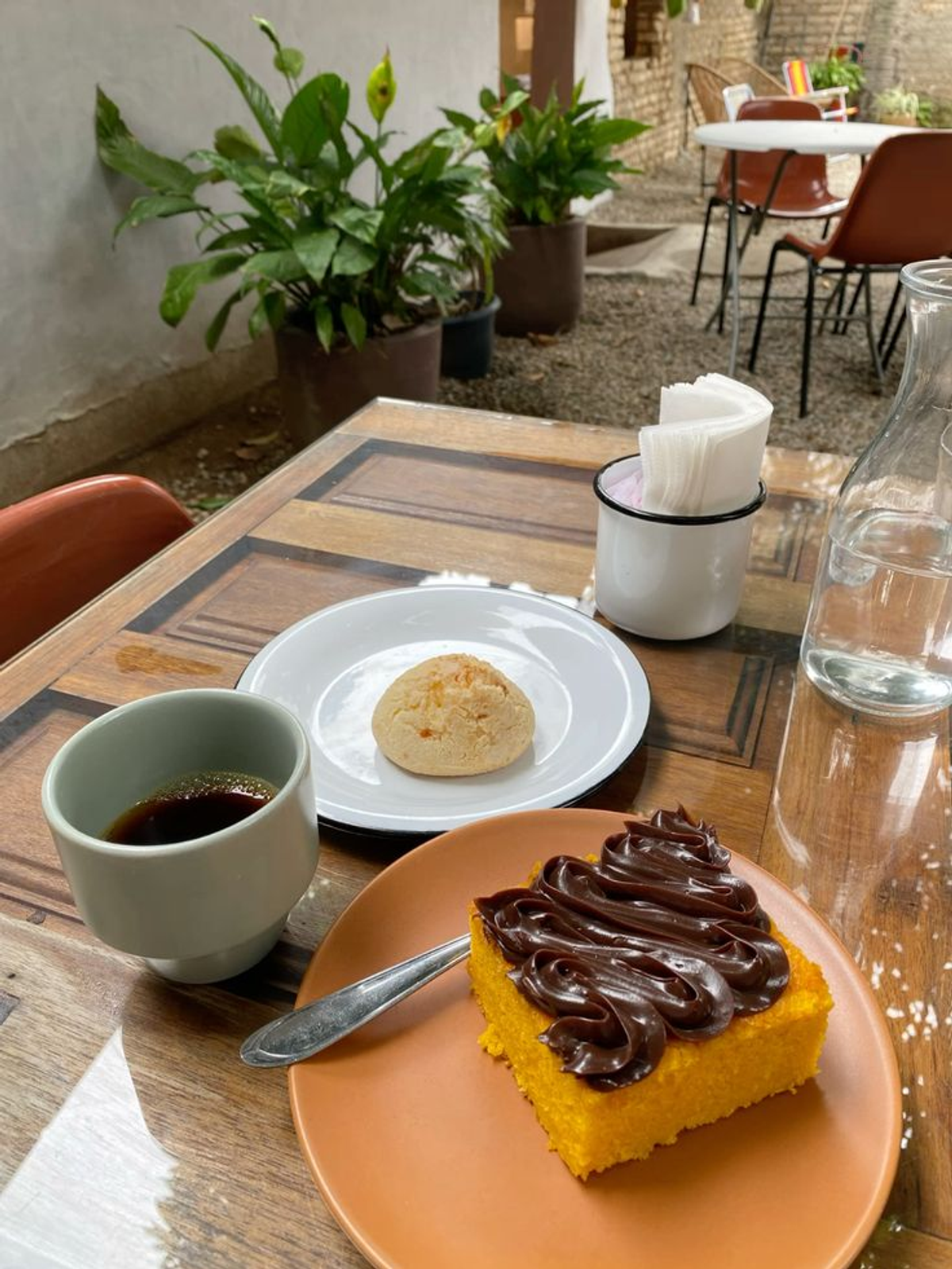
Three years later we were in a cafe, a bakery that offered warmth against the unseasonably cold day. The glass counters made the cheese bread, deep fried chicken croquettes and banana pudding tarts shine. It smelled like baked cheese and yeast, with the biterness of strong coffee contrasting with the sweets and mixing in the air. Portuguese filled the room, the musical rise and fall of the language filling the space with its smoothed edges.
People bustled in and out, the turnstile at the entrance banging with each rotation and the baristas calling out their complete orders to waiters. I grabbed my plastic card to track my selections, to be paid at the end by the entrance. It was a nice bakery, with soft lighting and potted plants decorating the cafe area, just to the right of the entrance where chocolate, peanut candies and bacon flavored chips were sold.
My host mom and I made our way through the post-work rush for fresh bread and sat at a table for two, the rain sliding down the window frame across the aisle from us. She reached across the table to hold my hands, her wedding ring cold against my fingers. I was a little nervous of her touch, but soak up her warmth and wait for the awkwardness of missed time to wash away. I needed time to defrost to Brazilian customs, adjust to their casual intimacy in hugs and kisses. I didn’t know how I was supposed to act here, not as an exchange student but just an adult who used to live here. The expectation of fully embedding myself in the culture was gone, fulfilled years ago. They had no responsibility to house me anymore, treat me as their own.
It left me uneasy, not knowing what would happen when I was not my host family’s charge, that they would simply spend time with me for the joy of it. Even after a few days of being back in Brazil, my Portuguese was awkward and riddled with errors, my tongue struggling to keep up with my brain. English is flat and single toned in comparison to Portuguese, with rolling a’s and soft d’s that smush into the next letter. Though my understanding of the language had remained, my mouth was being worked into knots, trying to not sound too gringa as I tried to pronounce the “ao” in words. Cristina was patient with me, gently correcting my errors as we made small talk about the last time we were there, how her dentist clinic was going and the weather.
I ordered a cappuccino, a sandwich and a tart. She ordered a mozzarella sandwich, a cafe normal and a banoffee tart. Banoffee is a Brazilian favorite, mixing dulce de leche with ripe bananas for the filling for a flaky pie crust. Cristina was careful with her forkfuls of food, well practiced in preventing them from staining her all-white clothes. It was the delicacy required of a dentist coming from her clinic. In my ripped jeans and striped sweater that my best friend called my “cool guitar player” top, I felt out of place and informal compared to her composed, professional look. Too much acne and too American to really look like the daughter that she introduced me to everyone as. The business casual style of the Brazilian upper-middle class was one that I couldn’t master, too uncomfortable with layers of makeup and perfectly pressed jeans. As much as I tried to envelop myself in the culture, some things would need longer than ten months. Our only commonality in appearance was our hair, both dirty blonde, though hers was created in a salon and mine has been lightened by years of living in the Sunshine State. We loved to eat, and share bites of our afternoon treats with each other as we eased into the serious catch up.
“Me conta tudo, o que es-esta? Acontecendo com a casa agora?” I asked her. Tell me everything, what is happening with the house now, I asked, tripping over my words and forgetting the tense.
It was her first year living in a new home, her first time moving in her life. Cristina was raised in the home she was born in, with four sisters and ever present, adoring parents. After they died, it became her and her husband’s home to raise their two sons, host parties in the backyard, and work on their mountain bikes. It’s been an adjustment, she tells me, but she likes the new home. Years after her mom died, they decided that they needed a change after being offered money by developers for the land, to create modern townhomes. It was time for a place of her own, away from her family’s history and the work of maintaining it, away from the linoleum counter tops and long hallways of their one level house. She’s lost weight since I saw her last, though her small body is petite and still curvy in the idealistic Brazilian form. She’s been going to the gym in the morning, pushing pilates with her friends while her husband bikes. She tells me it feels better to have lost weight, and I remember how she used to call herself pregnant-looking in photos. It was normal in the Brazilian communities that I knew to get bariatric surgery and lose weight, but she was indignant about no surgeries, just the gym and eating better. A necessity after having children, was what the middle aged women told me, along with a boob job to keep their hour glass form. It was one of the things I agreed with her on, coming from a family that ran half-marathons and had never stepped foot in a plastic surgeon’s office. I knew exercise to be bonding time, and she did too. We spent many weekends together with my host dad, hiking in the countryside of Parana and swimming in the springs.
Our plates almost empty, I soaked in her stories, filing them away with everything else I knew about her. These details were precious, learning about the authentic and real Cristina without the flatness of a screen or faded memories. Meeting her future husband at fourteen, loving her dentistry practice just down the street, preferring her younger son, Otavio, over her older and grumpier son, Gustavo. She folds her hands under her chin as she talks, her glasses slowly slipping down her nose. I listen as she talks about Gustavo’s new job, new fiance, and keep my opinions to myself. Despite my love for her, I couldn’t bring myself to engage with him in the same way after he celebrated Trump’s reelection on Instagram, writing, “America has finally come to its senses,”, with the red map behind it. He lacked the gentle touch of his mother, who, despite what I knew of her beliefs, was kind to everyone she met without exception. Including her son, who rejected the family in favor of moving to Germany. As much as I disliked hearing about him, it wasn’t worth losing Cristina over. It felt good to hear her voice in real life, listen to her and get to know this new version of her that I had missed out on in the two years away.
“Então, meu amor, você esta namorando?” she asks me, opening up the conversation to hear about my own life updates with the most essential question any Brazilian mom can ask. So, my love, are you dating now?
I took a breath, unsurprised to be asked the question but still had been holding onto hope that it would be forgotten. It had only been a few months since my girlfriend and I became official, and my sexuality became the front focus of my life. Though it was never a secret, I never felt the need to make it a big deal. I dated men, kissed women, and left it at the club or in the bedroom. I often forgot that I wasn’t labeled as straight anymore, but remembered the moment that anyone asked about my dating life and I told them the truth. Though I’d been a practicing bisexual when I lived with her, there was no need to share it with the community that I was a part of, aside from my friends that I went out with. However, it is hard to hide who you are when that means hiding a person you love, not just a piece of your identity.
She looked at me expectantly, asking what should have been an easy question. I had never shied away from talking about my love life with her, in fact, I had asked her on many occasions for her advice when I was dating men during my exchange year. It had been messy, between a high school sweetheart break up and exploring the Brazilian party culture with my fellow exchange students. Cris had a sort of wisened perspective on romance that came from her own deeply loving relationship of almost fifty years. I loved to ask her for advice when I was at my own crossroads, and hear her advice through stories of her and her husband. But then, it was terrifying. With the public expression of my love life shifted, I was scared that her beliefs would match those of the president she voted for, the president who preferred a dead son over a gay son.
“Sim,” I told her, yes.
Out of the dozen of exchange students that she had hosted, I was her only host daughter that has stayed in contact with her throughout the years. Her “unica filha” as she called me, her only daughter. There was something about being a mom to two boys and primarily hosting exchange student boys that never gave her the same connection as me, or so she told me. And I believed her, she treated me differently. Family friends had said that Cristina should’ve been a girl mom, her demeanor too sweet and nurturing for the rough nature of conservatively raised boys.
“Eu tenho uma namorada,” I told her. I have a girlfriend.
I expected to feel my heart drop, for the expected terror and rejection to meet me. Even in her all knowing and loving, I didn’t know what to expect in telling her that I was dating a woman. The years of hiding weighed on me, the comfort of being unseen chafing as my relationship progressed. I prepared myself for the worst before meeting Cristina at the cafe. If she couldn’t accept me as her queer daughter, I would make myself be okay with that. In coming out, I had been told by many that loving my girlfriend was a choice, that they would support me in my choice. The word “choice” grated, suggesting that my love for her was less genuine, decidedly harder. To the untrained ear it may sound supportive, yes, but doubtful as well. The stigma of “you’re just confused” echoed in hearing “it’s your choice.” It was exhausting to recieve, but I couldn’t keep this part of me to myself anymore. My relationship with Cristina felt too close, too authentic to not share my own real, authentic self. It took trusting the relationship, trusting her, and I wasn’t sure if I could do that. Conservative, traditional, Cris checked all of the boxes of someone who would believe that my love was something to doubt, just like my grandmother, just like my aunt.
“O que e o nome dela?” she asked me. What’s her name?
“Eleanor,” I told her.
“Eleanor, que linda,” she said. She held my hand across the table, pushing past our plates, rubbing the bottom of her thumb across my nails. I felt tears welling up, waiting for the other shoe to drop, waiting for her to tell me that she supported my choice. She looked at me, as if waiting to hear more. Without an immediate response, I told her about my girlfriend. That she loved to run with me, how we met at work over the summer, that she was smart as hell and wanted to go to school to be a nurse, to care for people. That she was kind, beautiful.
“Você esta enamorada,” she said. You are in love. Her eyes were steady on me through her comically large glasses. I didn’t realize I was crying until I laughed a gargled laugh that was mixed with tears, nodding and holding her hand tighter. I underestimated her, I think. She saw me, in this moment, in a way that I would have never imagined. She asked me about her, what her family was like, if she could ever meet her in Brazil. I felt a wash of relief, lightening and opening up to her questions. None of my family had asked me about Eleanor when I told them about her, instead focusing on the whole “gay” part of it.
I was wrong, I should say. I assumed that her vote was tied directly to her beliefs, that loving Bolsonaro meant hating gay people in the same way that he did. That her conservative, strongly anti-communist beliefs would mean that her love for me didn’t matter anymore. Ideology and politics are separate, but I did not consider that. I was too afraid before to ask what she really thought of gay people, assumed the worst to shield myself from it. I didn’t want to fit into the category of people that she voted against, knowingly or unknowingly. I assumed that her traditional upbringing had taught her differently, that this American girl who challenged the idea of who belonged in her community would be rejected, proved to be too different from who she considered family. Even if I was her daughter by heart, it was not by blood.
The memories of swimming in the ocean at night, pressing sea stars to stick to our skin, wouldn’t matter. Singing Brazilian music in the car with the rest of the family, talking about playlists. Long drives to Florianopolis, the salt sticking our thighs to the seats as we beach hopped, the floor of the car becoming more clouded with sand at each stop. Singing our song, “Fico Assim Sem Voce,” with her hand stretched to the back seat to hold mine on our last drive to the airport, my host dad humming the words with us. Maybe she would act differently with someone else, someone who she didn’t share these memories with, but to me, her daughter, she wasn’t. I wonder if it was the election that did it, that she saw the ex-president she loved so dearly in a different light once he was under house arrest for stealing from the country. Or maybe I’d been wrong all along, and her acceptance was beyond her vote.
It’s been a few months since we left that cafe now, and our connection again relies on WhatsApp messages. Maybe it wasn’t her politics that taught her who and how to love, but her family that lived in that house for a hundred years. The kind of love that made them stay together, that made her stay with her husband from the moment she met him as a teen. Maybe it was moving, discovering her own ability to forge a new path away from the history of her family. Maybe she was taught to stay, no matter the difference, because it had been the way of her life. Maybe it was both, blended into the loyalty of love. I wonder if that is what made her stay with me, listen to me talk in mixed up Portuguese about my partner and wipe the tears from my face.
“Eu te amo sempre,” she still tells me. I love you always.
“Eu também te amo mamãe,” I tell her. I love you too mamãe.
Amelie Curitiba · Minneapolis · 2026